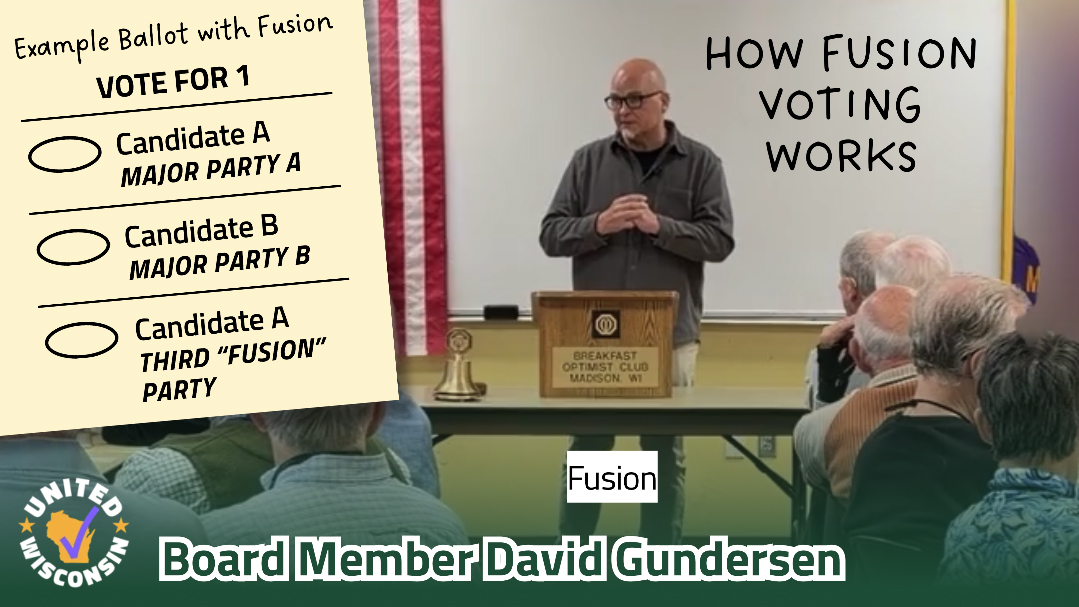
We need to un-ban, re-legalize, restore, and revitalize Fusion Voting. If restored, Fusion Voting could change modern politics at the local, state, and federal level.
Fusion Voting gives power to populists, moderates, and issue-driven voters — average citizens who have been locked out of our current political power structure. That’s why it was banned. Fusion Voting took power away from the two major parties and gave it to average citizens.
The mechanism of Fusion Voting can be confusing. The impact is not. Fusion Voting can fix our politics. If we want average citizens to have an equal voice in our politics, we need to restore Fusion Voting in Wisconsin and across the country.
If you want to understand how Fusion Voting can change our politics, explore the following to learn more (plus video explanation at bottom of page).
Here’s why we need Fusion Voting to help fix our politics.
Campaign finance reform. Data Centers. Property taxes. Gerrymandering. Wake boats. Power lines. Term limits. Fusion Voting can give citizens passionate about these issues the power to elect leaders who will act on their behalf – or risk losing the next election.
Fusion Voting gives power to average citizens by allowing them to be the swing votes in elections, not spoiler or wasted votes, or votes taken for granted by either of the two major parties.
Fusion Voting fosters collaboration across parties, creating incentive to create multi-party coalitions rather than antagonize each other.
Fusion Voting provides power to average citizens that can counter the ultra-wealthy and political elite dominating our politics.
Fusion voting can put us on the path to our democracy serving people, not parties.
Read on to learn how Fusion Voting works.
In its simplest explanation, Fusion Voting is an electoral tool that allows cross-party nominations of the same candidate. If Fusion Voting were restored, more than one political party could nominate the same candidate and place them on that party’s line on the election-day ballot. Voters would then choose which party line to vote for, and all votes for a given candidate would be added, or “fused,” across all the parties that nominated that candidate.
Here’s why that’s powerful and will change our politics.
There are two ways Fusion Voting helps third party votes determine the outcome of elections: The Swing Vote or create a Multi-Party Fusion.
The Swing Vote
If the nominee of one of the two major parties is in a close race, a third party can approach that candidate and offer its support if that candidate is willing to adopt their platform. With Fusion Voting, a third party can identify a specific number of voters who they can turn out in the election. In close races, if this number represents the difference between winning and losing, the issue forwarded by the third party suddenly becomes a monumentally important issue in the election.
Below: sample ballot with fusion voting – showing a third party cross-nominating a major party candidate
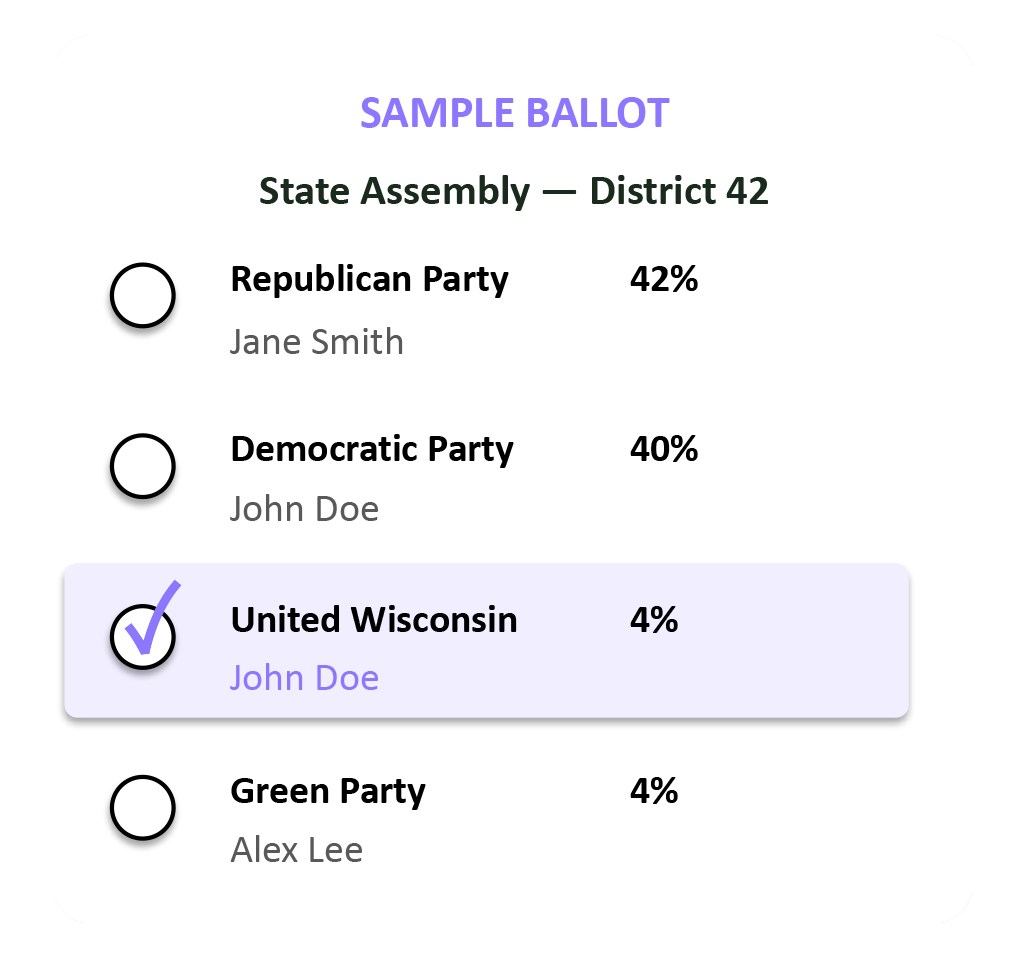
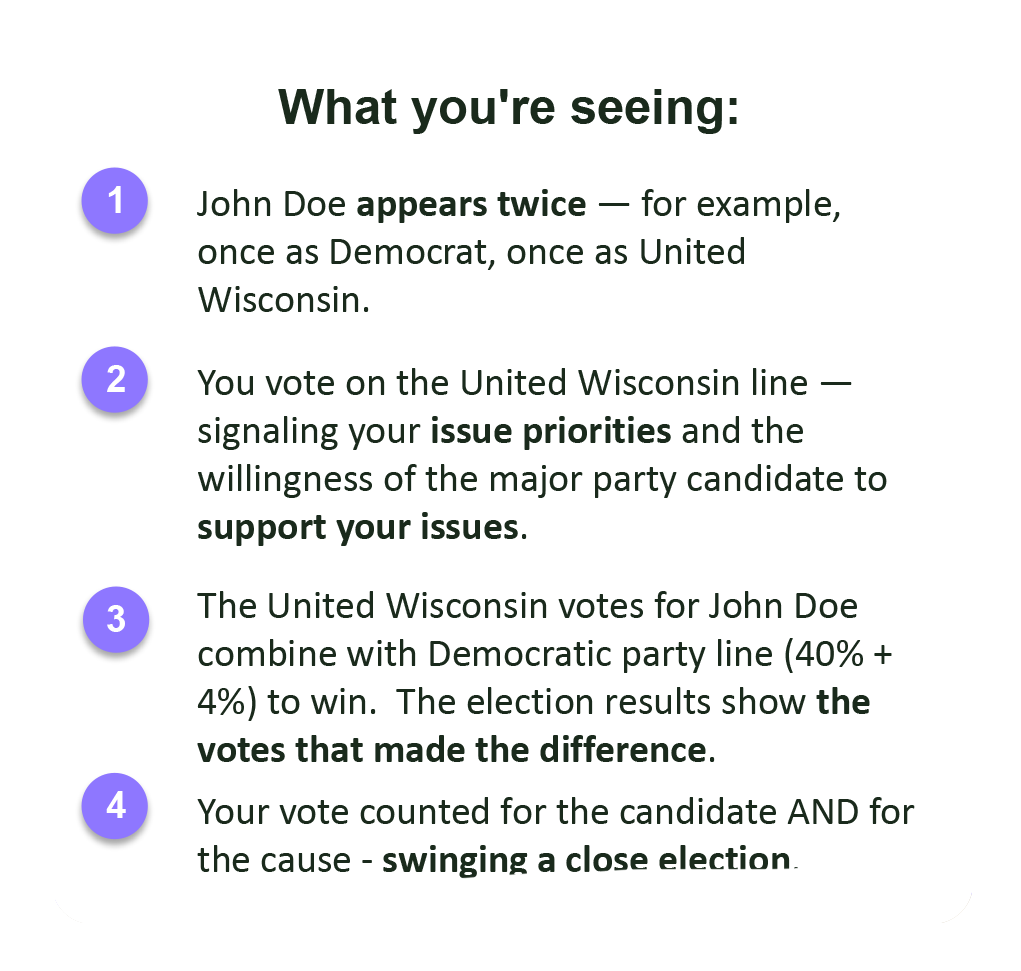
Fusion Voting shows exactly which issues swung the vote. If Fusion Voting is in place, not only can third parties organize around their values and priorities, but candidates from the major parties will need to actively champion those issues and court the party’s support. No longer will third party and minority voices be ignored. Their votes will no longer be wasted votes or spoiler votes. Their votes will be the difference in the election and the most important voices in the race.
The Multi-Party Fusion
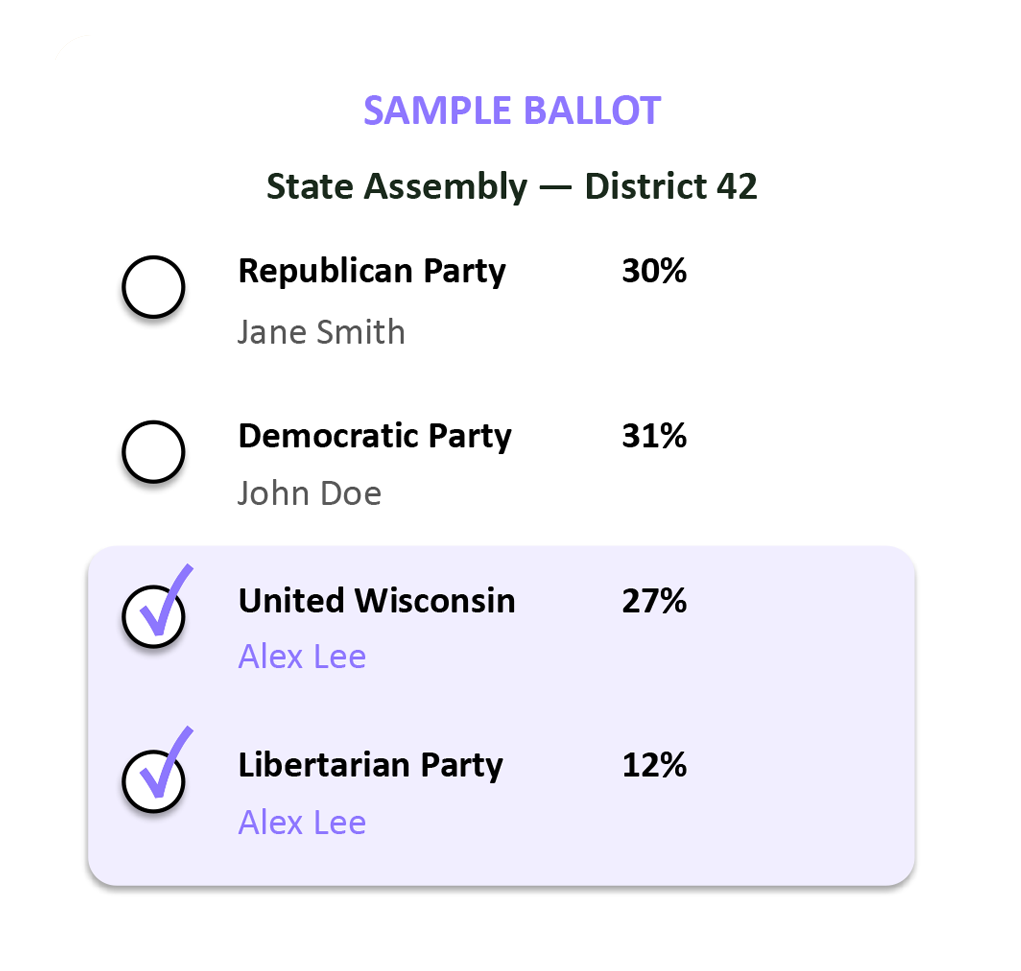
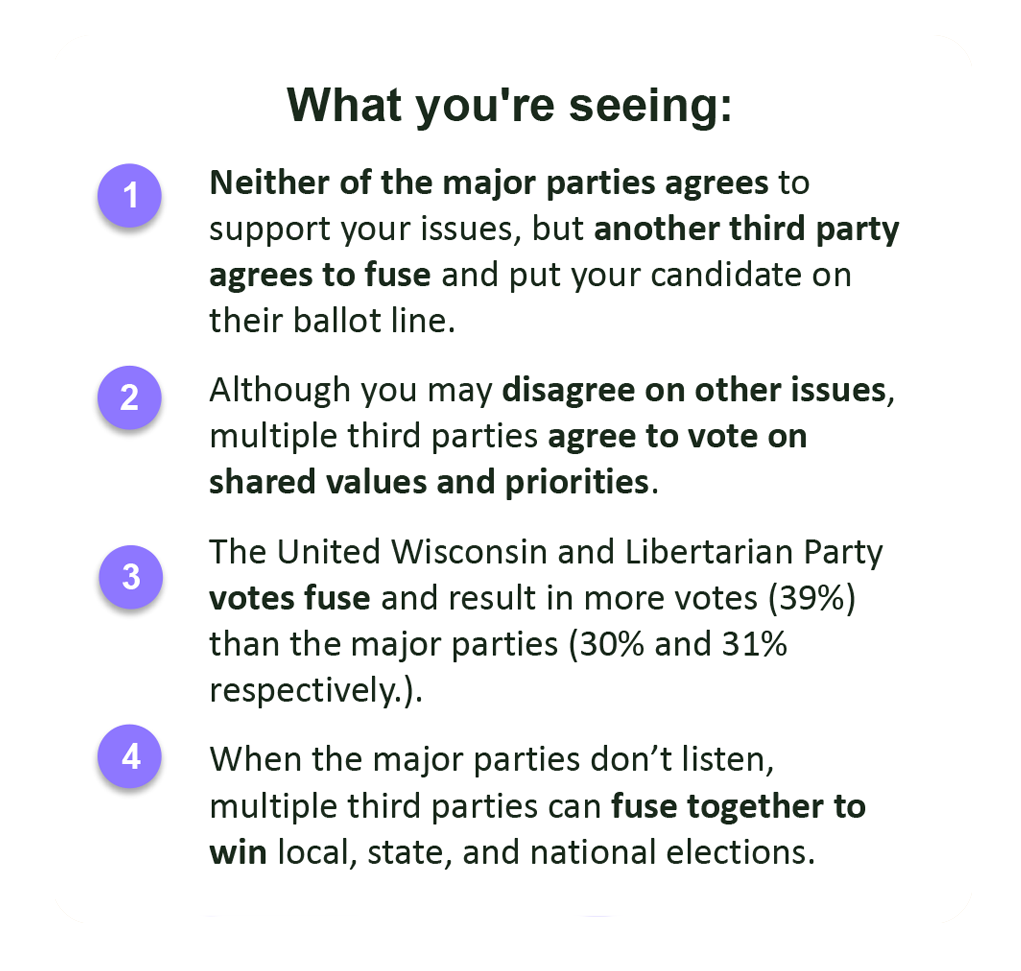
If neither of the major parties are willing to champion a third party’s issue, then it’s time to find other third parties who will join the fight. When two or more third parties are being ignored by the major parties, they can cross-nominate the same candidate. After negotiating on the best candidate, each party puts the name of the same candidate on their ballot. The votes from each party are then added together (see sample ballot). Cross-nomination across multiple third parties offers a true chance of beating the major party candidates.
Below: sample ballot with fusion voting – showing 2 third parties cross-nominating the same third party candidate
Q1. What kind of base would a centrist party be able to build?
- Current polling shows that more than a third of voters self-identify as independent of the two major parties and, in most cases, as ideologically centrist. Under fusion voting, a centrist party would need to deliver only a fraction of these voters to make the difference in competitive races, as noted in the 2016 and 2020 examples. Fusion voting allows groups of centrist voters to have a meaningful voice in the outcome of elections.
Q2. Could a centrist party help both ideologically moderate Republican and Democratic candidates?
- Absolutely. Ideologically moderate candidates in both parties will gain from the growth of a credible centrist party. That’s because voters who want to see the government move away from extreme ideology and towards broad-based policies that benefit the state and country as a whole will now have a viable choice at the polls.
Q3. What about the extreme left and right? Won’t they form fusion parties that yank the Democrats further to the left and Republicans further to the right? Won’t that make us more polarized, not less?
- Fusion voting in the 21st Century will actually reduce the extreme partisanship that exists currently between the two major political parties by creating an incentive for political cooperation, collaboration, and compromise through coalition building with voters in the center of the political spectrum. It will, in fact, allow centrists to re-assert themselves by identifying and organizing as a political entity. By having a centrist political party with nominated candidates on the ballot, voters can do more than say they are ideologically moderate–they can actually demonstrate that commitment with their votes. Instead of separating us further politically, that should bring us closer together.
Q4. Will this benefit one major party over another?
- It could benefit or hinder both major parties, depending on the race and the candidates. The biggest beneficiary of fusion voting–both in the short and long term–will actually be our democratic system of government because it will give voters more meaningful choices, increase competition, and in today’s hyper-polarized climate it will empower centrist voters to reassert their influence in both political parties, not just one or the other.
Summary
Unless we change the current rules of the road for the American political highway by re-establishing a pathway for voters down its center, our democratic system of government will be difficult to sustain. Fusion voting is not the only structural political reform needed in Wisconsin and around the country but, in the current moment, it’s the achievable one that we need the most. Download a fact sheet here or see our elevator pitch here.
More reading…
The Case for More Parties: A Path Beyond Our Broken Two-Party System, by Lee Drutman, Boston Review, September 2024.
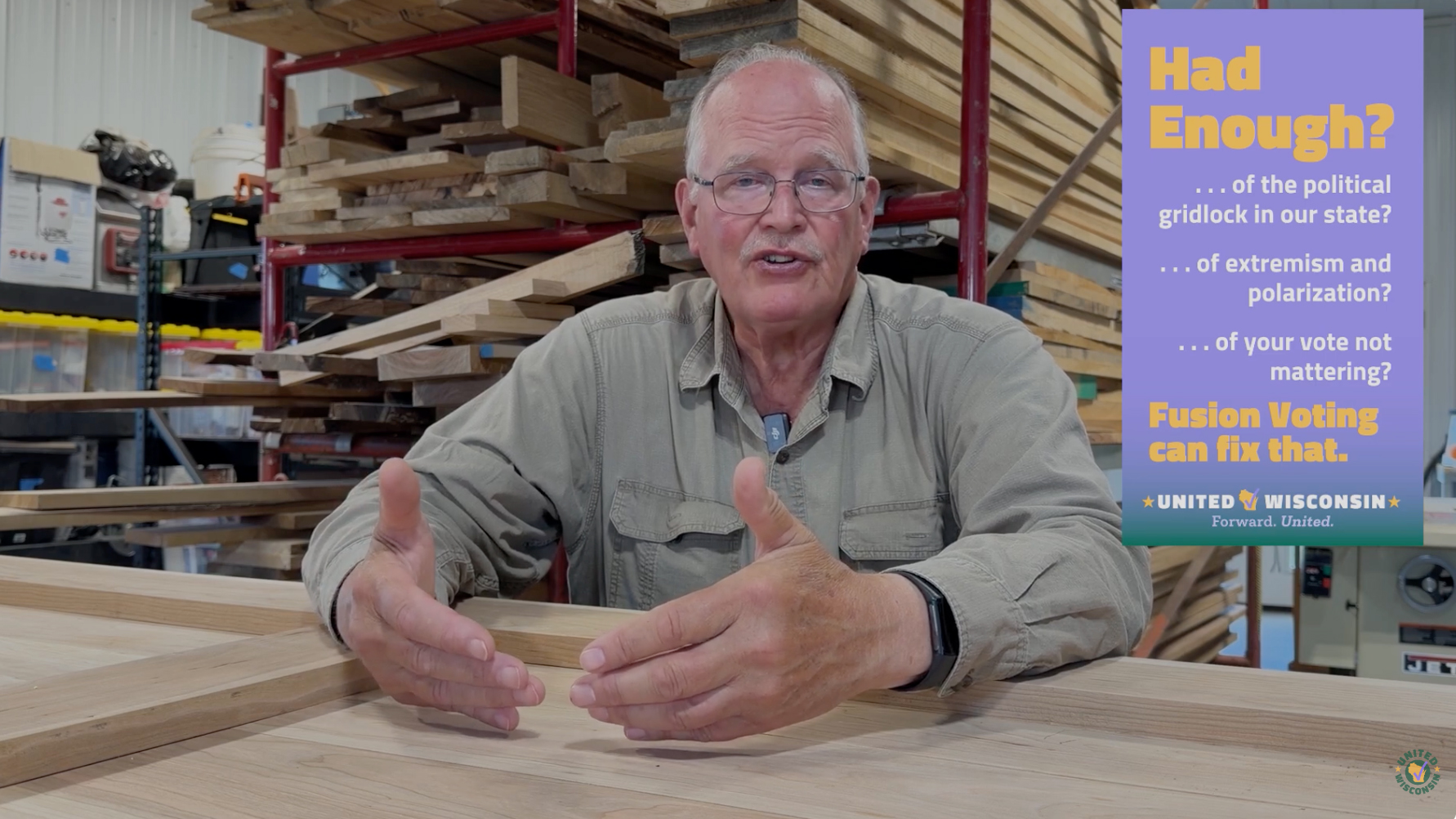
Fusion Voting explained by Co-Chair Dale Schultz